Showing posts with label astronomy. Show all posts

Tuesday, January 6, 2015

Kepler confirms 1,000th Exoplanet and habital zone discoveries!


NASA has just made an announcement that they've confirmed a thousand extrasolar worlds and three of the latest are in their stars' habitable zones.

 (Click the images above to enlarge.)
"Each result from the planet-hunting Kepler mission's treasure trove of data takes us another step closer to answering the question of whether we are alone in the Universe," said John Grunsfeld, associate administrator of NASA’s Science Mission Directorate at the agency’s headquarters in Washington. “The Kepler team and its science community continue to produce impressive results with the data from this venerable explorer."
The planets were validated as part of a survey of more than 4,000 objects. In addition, 554 further candidates were added to the mission for study. 

This is truly an amazing universe we live in. No longer are we bound by science fiction---we live in a universe with a cool grand in new, unexplored worlds!

Read NASA's statement for the full announcement.

Images: NASA

Tuesday, December 2, 2014

VIDEO: Inspiring short films about "boldly going"

Here's a fantastic short film based on Carl Sagan's "Pale Blue Dot" speech that captures the energy and spirit of the late astronomer by setting it to some beautifully composed visuals. The film, Wanderers, is by Erik Wernquist, and it's candy for the eyes as well as the heart.


Wanderers - a short film by Erik Wernquist from Erik Wernquist on Vimeo.


Love this still from the film:


Between this and October's Ambition short from the European Space Agency, we're riding a streak of really captivating shorts about space exploration.

The next was suggested by reader Graham. It's titled Man Conquers Space, and I'm afraid I don't know much about it, but looks to be an upcoming independent film. This is actually more of a trailer, but it makes good use of one of Wehrner Von Braun's finned rocket designs.


Friday, October 31, 2014

Revenge of the Jack o' Lantern Star


NASA recently captured a devilishly cool pic of the sun a few weeks back, complete with fiery prominence grin and glowing eyes. You can even download  high-res versions.

Happy Halloween!

Wednesday, March 26, 2014

First Ringed Asteroid Discovered!


NASA announced today an intrasolar oddity--a Centaur astroid called Charilko looks to be the first ever ringed asteroid system. The rings are likely made up of ice drummed up from another object impacting the asteroid, which sits between Saturn and Uranus.

From Wired:
At 155 miles across, or about the length of Massachusetts, Chariklo is the largest known asteroid in its neighborhood. Looking to get a better idea of its exact size and shape, astronomers trained their telescopes on the giant space rock as it passed in front on a distant star in June 2013. As Chariklo performed its eclipse, researchers noticed something odd: The star’s light flickered just a bit immediately before and after Chariklo’s pass.

The reason for this darkening was the asteroid’s two dense rings, which had briefly blocked the starlight. The thicker inner ring is about four miles wide, while the thinner outer ring is a little less than two miles. Spectroscopic analysis of the starlight also revealed that the rings are composed partially of water ice.
Pretty sweet discovery--and it doesn't sound like astronomers had expected it!

Click to enlarge:


Arist conception by artist Lucie Maquet

More coverage:

Sunday, March 9, 2014

COSMOS premieres TONIGHT!


With Neil DeGrasse Tyson! At 8:00 p.m. Central! That's in, like, A MINUTE!


Monday, November 4, 2013

STUDY: 1 in 5 stars like our sun have planets in a habitable zone!


NASA recently completed analysis of Kepler telescope data and findings form the Keck telescope in Hawaii, examining  stars similar to our sun (G and K type). They were looking for candidates that might have planets in habitable "Goldilocks" zones.

Scientists focused on 42,000 stars and found more than 600 planets--10 of those are Earth-sized in habitable zones! From Universe Today:
Since there are about 200 billion stars in our galaxy, with 40 billion of them like our Sun, noted planet-hunter Geoff Marcy said that gives us about 8.8 billion Earth-size planets in the Milky Way.

...and...
“For NASA, this number – that every fifth star has a planet somewhat like Earth – is really important, because successor missions to Kepler will try to take an actual picture of a planet, and the size of the telescope they have to build depends on how close the nearest Earth-size planets are,” said Andrew Howard, astronomer with the Institute for Astronomy at the University of Hawaii. “An abundance of planets orbiting nearby stars simplifies such follow-up missions.”


While it's true not all are likely to be hospitable to life, this gives researchers a specific pool of candidates to examine for further study. Looks like more great news for exoplanet research!!

Read more at Universe Today

Saturday, October 26, 2013

A THOUSAND Worlds and Counting!

This week, the number of exoplanets reached 1, 010! It's been more than 20 years--1992, to be exact-- since the first confirmed extrasolar planet (a.k.a. a planet outside our solar system). Since then, the tools have vastly improved from Earth-based telescopes that had to contend with atmospheric interference to space-based ones like the Kepler telescope which has been racking up finds since 2009. 

The field of exoplanet research has expanded beyond just locating planets, it now encompasses classification--separating the gas giants from the rocky abodes--in the hopes that another Earth-like planet might be found.

As of today, eight candidates have been identified as being in the "Goldilock's Zone" of their respective parent stars (i.e., sustainable temperature for liquid water), where life--at least as we know it on Earth--might have the best chance to thrive. 

In the meantime, the bounty of alien worlds has been plentiful. From NBC News:
Indeed, the current tally is likely just the tip of the exoplanet iceberg. For example, a study published last year estimated that every star in the Milky Way hosts 1.6 planets on average — meaning that our galaxy likely harbors at least 160 billion alien worlds.

And those are just the planets with obvious parent stars. Another recent study calculated that "rogue planets" — those that cruise through space apparently unbound to any star — may outnumber "normal" worlds by 50 percent or so.

The number of confirmed planets should continue its dramatic upward swing in the near future as astronomers continue to hone their techniques and analyze data collected by instruments on the ground and in space. 
Here's to the search for an alien Earth and all the exoplanets yet to be discovered!

Update: Here's a nice little video recently put together by MIT, explaining some exoplanet basics:


More details:


Friday, April 19, 2013

An incredible new view of the Horsehead Nebula

NASA/ESA/Hubble Heritage Team
NASA has released a new image of everyone's favorite gaseous equine-shaped stellar object. But don't take my word for it. Straight from the --uh, horse's mouth:
Astronomers have used NASA's Hubble Space Telescope to photograph the iconic Horsehead Nebula in a new, infrared light to mark the 23rd anniversary of the famous observatory's launch aboard the space shuttle Discovery on April 24, 1990.

Looking like an apparition rising from whitecaps of interstellar foam, the iconic Horsehead Nebula has graced astronomy books ever since its discovery more than a century ago. The nebula is a favorite target for amateur and professional astronomers. It is shadowy in optical light. It appears transparent and ethereal when seen at infrared wavelengths. The rich tapestry of the Horsehead Nebula pops out against the backdrop of Milky Way stars and distant galaxies that easily are visible in infrared light.

Hubble has been producing ground-breaking science for two decades. During that time, it has benefited from a slew of upgrades from space shuttle missions, including the 2009 addition of a new imaging workhorse, the high-resolution Wide Field Camera 3 that took the new portrait of the Horsehead.<
You can download a wallpaper-sized version at NASA's image gallery.

Tuesday, January 15, 2013

Hey, here's a 3D image of a nebula


Here's a nice little "holographic" starmap for your next night at the gaming table (or hyperfuel for your next fan fiction). It's a an animated .gif in 3D of cosmic cloud Melotte 15 in the Heart Nebula, IC 1805 by astro photogropher J-P Metsävainio.

It's essentially a stereograph of an object in space. So I have to ask--why aren't we doing this for EVERYTHING IN SPACE? I'm thinking we need to tie two Hubbles together. Should be easy! #NASAMAKEITHAPPEN

Okay, maybe not. But it's pretty cool, huh?


Full article at Universe Today

Thursday, January 3, 2013

What would a wet Mars look like?

 
One of my favorite science fiction series are the Red Mars (then Blue, then Green) from Kim Stanely Robinson. It's a superbly researched and a fascinating look at what it would cost (in more than economic terms) to change the face of the red planet to one that could support life. But I've often wondered, what would it really LOOK like to see Mars as we know and experience the Earth--as a blue/green orb flocked with plant life and steeped in oceans.

Kevin Gill is a software engineer who has wondered the same and he took to making his own renderings, which--even if not completely accurate--are incredible:

A conception view of the Western hemisphere of Mars with oceans and clouds. Olympus Mons is visible on the horizon beyond the Tharsis Montes volcanoes and the Valles Marineris canyons near the center. 

A visualization of an Earth-like Mars, be it ancient or a future of terraforming. Eye position is about 6,600 kilometers (4100 miles) from the surface of the planet and looking at the southern hemisphere (~20° South) and the 180th meridian.

The Western hempisphere looks particularly intriguing with retaining its arid climate. Looks vaguely like the deserts of Spain to me. And the second image makes me think of the Irish countryside (Shire?). Perhaps I have to much hobbit on the brain. Truly inspiring stuff.

What do the images make you think of?

Wednesday, November 14, 2012

IMAGE: First exoplanet without a sun spotted!


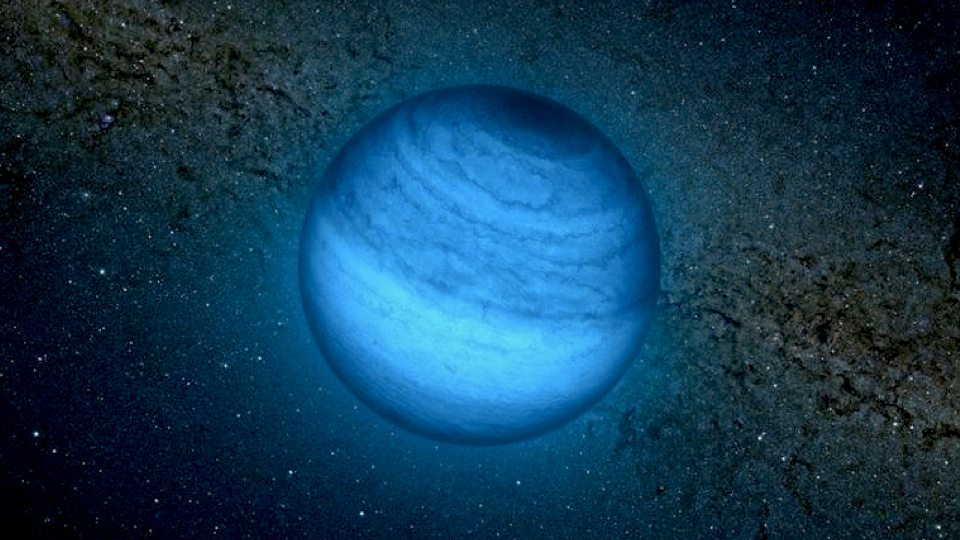
Feast your eyes on that pale blue dot (lower right) folks--this is the first CONFIRMED rogue planet discovered outside our solar system! We've already detected the existence of billions of others) But this is the first one we've laid eyes on--land it's less than 100 light years away!

Just think: it's out there alone...combing it's pomador...scoping the universe for chicks.

Artists interpretation:

Wait, here's a better one:


So what do we know about the inscrutably named CFBDSIRJ2149? From io9:
Located just 100 light years from Earth, it's the nearest free-floating planet candidate ever discovered. It's big (around 4—7 times the mass of Jupiter), but not too big. Objects more than 13 times the mass of our solar system's largest planet are considered to be not planets at all, but brown dwarfs. It has company; the planet appears to belong to a traveling band of celestial objects known as the AB Doradus Moving Group. It's also very cool. In visible light, the planet would be a dim, deep-red color. In the images seen here the planet appears blue, as light at longer IR wavelengths are thought to have been absorbed by molecules in the planet's atmosphere.
Rogue planets are often dubbed "orphans" having no "parent" star. But it shouldn't be assumed that they're always frozen, lifeless hells, some scientists believe that rogue planets could have their own internal heat that might make for more habitable conditions (think bacteria or sea plankton here).


Meanwhile, back on Earth, there's an effort by space enthusiast group Uwingu to get a book published to help exoplanets get real names that don't resmble barcode vomit. Via NBC News.

Big ol' tip of the bubble helmet to io9.com.

Also, LA times, CBS News, and the BBC.

Video: Space.com

Images: L. Calçada, P. Delorme, Nick Risinger, R. Saito, European Southern Observatory/VVV Consortium

Wednesday, August 29, 2012

NASA: We found 2.5 million supermassive black holes gorging themselves


DUDE. Don't look up, lest your eyeballs be sucked into any one of 2.5 MILLION supermassive black holes currently digesting spacetime. NASA announced today that they've pinpointed the suckers (ha!) using the Wide-field Infrared Survey Explorer (WISE) space telescope.

All those little circles are really reality-ripping hot DOGs (dust obscured galaxies) with black holes at their centers that care not for your puny "sentience" or pleas for mercy. NOM-NOM-NOM. From Universe Today:
WISE scanned the whole sky twice in infrared light, completing its survey in early 2011. Like night-vision goggles probing the dark, the telescope captured millions of images of the sky. All the data from the mission have been released publicly, allowing astronomers to dig in and make new discoveries.

The latest findings are helping astronomers better understand how galaxies and the behemoth black holes at their centers grow and evolve together. For example, the giant black hole at the center of our Milky Way galaxy, called Sagittarius A*, has 4 million times the mass of our sun and has gone through periodic feeding frenzies where material falls towards the black hole, heats up and irradiates its surroundings. Bigger central black holes, up to a billion times the mass of our sun, may even shut down star formation in galaxies.

In one study, astronomers used WISE to identify about 2.5 million actively feeding supermassive black holes across the full sky, stretching back to distances more than 10 billion light-years away. About two-thirds of these objects never had been detected before because dust blocks their visible light. WISE easily sees these monsters because their powerful, accreting black holes warm the dust, causing it to glow in infrared light.
It's funny, but quasars always seem to come up as "extroverts" on the Myers Briggs.
WISE actually picked up other objects too, including asteroids, quasars, and a whole mess o' other stuff that you probablly think is cool, but should thank your stars isn't headed this way.


STAY IN SCHOOL, BECAUSE SCIENCE. IS. COOL.


Coverage:

Wednesday, August 22, 2012

HD VIDEO: Curiosity's descent onto Mars as filmed from orbit


Absolutely incredible! This was apparently compiled into a video using images from the MARDI Descent Imager. What you see at the beginning is the heat sheild being shed. Followed by the rover's P.O.V. descent, via sky crane.

UPDATE: Here's a new "smoothed" version that's easier to follow, visually. Props to Boing Boing.

Sunday, August 5, 2012

CURIOSITY LANDS TONIGHT!

If you haven't seen this "Seven Minutes of Terror" video detailing the difficulties of landing a one-ton rover on the Red Planet tonight, then here it is, in all it's nail-biting glory:


NASA is running a live feed right now.

io9.com has a great bunch o'links too.

Here's to Curiosity sticking the landing!

Expiscor Eternus!

UPDATE: NASA has confirmed Curiosity has landed safely on Mars. SCIENCE ROCKS!

Tuesday, April 24, 2012

GOLD RUSH IN SPACE! Asteroid Mining is Coming!

So it seems my previous post kicking off a new adventure was more timely than I thought: space mining is the next big thing! Planetary Resources Inc., which may as well be called Rich Billionaires Inc., is a consortium of wealthy space geeks who want to start mining asteroids for mineral commodities. With almost 9,000 known asteroids out in the Mars-Jupiter belt that might go for as much as a billion bucks a piece, this isn't as far-out as it initially sounds.

From Wired.com:
In terms of extraction, Planetary Resources hopes to go after the platinum-group metals — which include platinum, palladium, osmium, and iridium — highly valuable commodities used in medical devices, renewable energy products, catalytic converters, and potentially in automotive fuel cells.

Platinum alone is worth around $23,000 a pound — nearly the same as gold. Mining the top few feet of a single modestly sized, half-mile-diameter asteroid could yield around 130 tons of platinum, worth roughly $6 billion.

Within the next 18 to 24 months, Planetary Resources hopes to launch between two and five space-based telescopes at an estimated cost of a few million dollars each that will identify potentially valuable asteroids. Other than their size and orbit, little detailed information is available about the current catalog of near-Earth asteroids. Planetary Resources’ Arkyd-101 Space Telescopes will figure out whether any are worth the trouble of resource extraction.

Within five to seven years, the company hopes to send out a small swarm of similar spacecraft for a more detailed prospecting mission, mapping out a valuable asteroid in detail and identifying rich resource veins. They estimate such a mission will cost between $25 and 30 million.

The group is also planning on using robots to do the mining (reducing human risks) as well as shipping it home.

If there's anything that will get private enterprise to drive a new space race folks--THIS IS IT. And with it, here's hoping a few thousand scientific discoveries along the way.

Check out the cool videos put up by ABC News
More at Gizmodo

Image: Artist concept by Denise Watt for NASA

Tuesday, February 21, 2012

Watery Exoplanet Discovered!

Hubble Telescope scientists are reporting the discovery of a new class of expolanet--a water world. Planet GJ1214b is larger than Earth but smaller than Uranus (tee hee!) and orbits a red dwarf star. From Hubblesite.org:
They found the spectrum of GJ1214b to be featureless over a wide range of wavelengths, or colors. The atmospheric model most consistent with the Hubble data is a dense atmosphere of water vapor.

"The Hubble measurements really tip the balance in favor of a steamy atmosphere," Berta said.

Since the planet's mass and size are known, astronomers can calculate the density, of only about 2 grams per cubic centimeter. Water has a density of 1 gram per cubic centimeter, while Earth's average density is 5.5 grams per cubic centimeter. This suggests that GJ1214b has much more water than Earth does, and much less rock.

As a result, the internal structure of GJ1214b would be an extraordinarily different world than our world.

"The high temperatures and high pressures would form exotic materials like 'hot ice' or 'superfluid water,' substances that are completely alien to our everyday experience," Berta said.

Theorists expect that GJ1214b formed farther out from its star, where water ice was plentiful, and migrated inward early in the system's history. In the process, it would have passed through the star's habitable zone, where surface temperatures would be similar to Earth's. How long it lingered there is unknown.

GJ1214b is located in the direction of the constellation Ophiuchus, and just 40 light-years from Earth. Therefore, it's a prime candidate for study by the planned James Webb Space Telescope.
So a few important items to note here beyond the facts and figures.

1: At first glance it appears that the intense atmospheric pressure could be hostile to most life on Earth, but if you recall, we've found microbes, worms, and other simple organisms thriving in heat vents on the ocean floor, so anything is possible.

2: Hubble is still a relevent and extraordinary piece of equipment for finding planets--and not just an instrument for deep space only missions. It's a shame that its life expectancy won't be lengthened, but it's nice to know that the exoplanet work carried out by the James Webb Telescope can earmark GJ1214b for future study.

Bonus excersise: If life does exist on this steamy, high-pressure world, what form do you think it takes? Feel free to speculate in the comments....

Read the full article on Hubblesite.org.

Wednesday, January 11, 2012

NASA: 100+ Billion Planets in the Milky Way


NASA has conducted a recent survey of our home galaxy and through the sheer power of statistics, came up with this astonishing find:
The survey results show that our galaxy contains, on average, a minimum of one planet for every star. This means that it’s likely there are a minimum of 1,500 planets within just 50 light-years of Earth.

The study is based on observations taken over six years by the PLANET (Probing Lensing Anomalies NETwork) collaboration, using a technique called microlensing to survey the galaxy for planets. In this technique, one star acts like a magnifying lens to brighten the light from a background star. If planets are orbiting the foreground star, the background star's light will further brighten, revealing the presence of a planet that is otherwise too faint to be seen.

The study also concludes that there are far more Earth-sized planets than bloated Jupiter-sized worlds. A rough estimate from this survey would point to the existence of more than 10 billion terrestrial planets across our galaxy.
They seem to be on to something--three more smaller-than-Earth-sized exoplanets were just discovered.

All of this comes on the heels of last month's discovery of Kepler22-b, hypothosized to be the first habitable planet outside our own solar system.
Kepler22-b; artist's rendering

And the 100 billion+ discovery STILL does't count the billion+ rogue planets thought to be out there as well.

It's such an exciting moment for science and the whole human race. I'm really, profoundly moved just to be hearing news like this. Take a moment and think about this pale blue dot we live on and it's true place in the universe, and sheer promise of what lies out there waiting for us to discover.


The Milky Way study will appear in tomorrow's issue of Nature.

All images: NASA

Tuesday, September 13, 2011

A habitable-zone exoplanet discovered in new crop of 50 finds

Star HD 85512; image via ESO and Digitized Sky Survey 2; Photo by: Davide De Martin
Let's get something straight--digging up exoplanets can be tedious work--but the pay-off can sometimes be incredible. Using extremely sensitive equipment, astronomers look for a "wobble" in a star's path that might be caused by a planetary body. When the technique was first used to find possible planetary systems, gas giants made up the early finds (Saturn and Jupiter-sized) because they were big and had a lot of mass to indicate planet's orbit.

As the technique has been refined, smaller planets often considered to be rocky like Earth--though there's no definitive proof yet of their composition--are now being picked up. Five such smaller planets have recently been detected--one of them lies in the Goldilocks Zone that would allow for liquid water and possibly life to exist. This exciting news comes from the BBC:
Of the new finds, a total of five planets have masses that are less than five times that of Earth.

"These planets will be among the best targets for future space telescopes to look for signs of life in the planet's atmosphere by looking for chemical signatures such as evidence of oxygen," said Francesco Pepe, from the Geneva Observatory, who contributed to the research.

The star HD 85512 lies some 35 light-years away and hosts a potentially habitable planet. One of the worlds, called HD 85512 b, is estimated to be only 3.6 times the mass of the Earth.

It is located at the edge of the habitable zone - the narrow strip around a star where liquid water can be present on the surface of a planet. Liquid water is considered essential for the existence of life.
That's the star pictured above. Get the full story or check out the Exoplanets link above for more resources.

Thursday, August 11, 2011

STARGATE?

Image: NASA, ESA, and the Hubble Heritage Team (STScI/AURA)
Looky what Hubble found:
A giant cosmic necklace glows brightly in this NASA Hubble Space Telescope image.

The object, aptly named the Necklace Nebula, is a recently discovered planetary nebula, the glowing remains of an ordinary, Sun-like star. The nebula consists of a bright ring, measuring 12 trillion miles wide, dotted with dense, bright knots of gas that resemble diamonds in a necklace.

A pair of stars orbiting close together produced the nebula, also called PN G054.2-03.4. About 10,000 years ago one of the aging stars ballooned to the point where it engulfed its companion star. The smaller star continued orbiting inside its larger companion, increasing the giant’s rotation rate.

The bloated companion star spun so fast that a large part of its gaseous envelope expanded into space. Due to centrifugal force, most of the gas escaped along the star’s equator, producing a ring. The embedded bright knots are dense gas clumps in the ring.

The pair is so close, only a few million miles apart, they appear as one bright dot in the center. The stars are furiously whirling around each other, completing an orbit in a little more than a day.

The Necklace Nebula is located 15,000 light-years away in the constellation Sagitta. In this composite image, taken on July 2, Hubble’s Wide Field Camera 3 captured the glow of hydrogen (blue), oxygen (green), and nitrogen (red).
Wonder where the other end is.  ;)

Thursday, September 30, 2010

FIRST EARTH-LIKE EXOPLANET DISCOVERED!!!!

Our science officer has identified the first M-class planet capable of supporting life, just 20 light years off the port bow.
You know what they say--go boldly or go home!

Expiscor Eternus!